Friday, November 21, 2014

A Moment in History

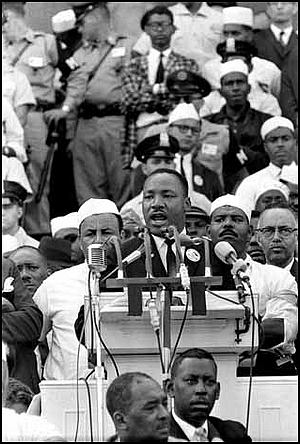
And when this happens, and when we allow freedom ring, when we let it ring from every village and every hamlet, from every state and every city, we will be able to speed up that day when all of God's children, black men and white men, Jews and gentiles, Protestants and Catholics, will be able to join hands and sing in the words of the old Negro spiritual, "Free at last! Free at last! Thank God Almighty, we are free at last!"


"My Favorite Moment in History?" This is such a difficult question for me to answer. Honestly, I truly do not know my favorite moment in history. I first started thinking about politics, wars, presidents etc. But then I realized I don't know enough about any of these topics to go into detail about them. I then started thinking about moments in history dealing with sports. I tried to think of the Olympics, decathlons and many more. The only things that were popping into my head were horrific moments in history.
        I went back to think about my U.S History class in high school. This was easy for me because the teacher who taught this course was one of my favorite teachers I have ever had. He made learning fun and interesting. I hate learnig about history, but he taught it in a way that made it easy to remember. We spent weeks talking about Martin Luther King " I Have A Dream" speech. This moment was a huge part of history. In my class each student had to memorize a line from the speech. We then all had to be recorded saying the line. Our teacher put the lines together and formed his speech from all of our parts.
    MLK Jr. was an American pastor, activist, humanitarian and leader in the African American Civil Rights movement.He is best known for his role in the advancement of civil rights. He was an inspiration to all.

Wednesday, November 19, 2014

Who Inspires me Most


           Many people inspire me everyday. I am inspired by celebrities, friends, teachers, but most importantly my Mom and Dad. They have inspired me my whole entire life. I honestly do not know where I would be if I didn’t have them. I would say they are my rock. Lots of people grow up with a house full of siblings but not me. I am an only child so it has always been just mom, dad and me. I love it that way. I could not picture or want my life any other way.
            My Mom works as a general manager of a great restaurant. My Dad works at a company called BriCo. His company deals with environmental services, disposal of hazardous and non-hazardous materials, and abatement.
            My parents have done everything in their power to give me the best life they possibly can and they have. Both my parents are so hardworking. My parents are brave; they will do anything for my happiness. They have always inspired me to do the right things, to be strong, and be independent.

            They have taught me so many things in life. From how to kick a soccer ball, how to be successful in school, how to drive, how to have fun, how to work hard, to be a good person, all the best shopping places, and many, many more. They have taught me about very serious things as well as fun things.  My parents taught me the saying, work hard- play hard. They have helped me through a lot of important decisions and always seem to know what to do.
            One great thing about them is they never made me feel pressured to do anything that was not interesting to me. Instead, they tried to show me everything they could to enable me to develop my own passions and make my own choices. This was with just about anything, for example, sports, girl scouts, student council and many more.
            I want to have a good education so I can have everything I want and be able to give my children anything they want. Having a good education is very important to get where you want to be in the future.  They have taught me, if you do not have an education, the possibilities of you having the life you want are slim to none. That is why my  parents  have pushed me to go to college. I have always wanted to go to college, but they have allowed me to follow this dream. Anytime I get a good grade on a test or do something well the first thing I think of is “ I can’t wait to tell mom and dad.”  I feel proud to be able to share my success with them. I want them to be apart of my life for everything. They have always been my biggest supporters. Whenever I am down, I know they will be right there to pick me back up.

                                                Thanks Mom and Dad!

What fictional hero did you look up to?


         Growing up I never was into heroes. Most kids would spend their Sunday afternoons watching cartoons about Batman, Superman, and the Hulk etc. A lot of kids were also into comics. I would have considered myself a “girly-girly” so that kind of stuff never interested it. If I was with friends or cousins and they were watching it then I would.
             The only fictional heroes that I was interested in were the girl ones. When I would watch the Power Rangers, I only focused on the pink power ranger. I also liked Wonder woman and Cat women.

The Powerpuff Girls – Blossom, Bubbles, and ButtercupPink letters reading "The Powerpuff Girls" against a black background.            If I had to pick a fictional hero that I looked up to then it would be Bubbles from The Powerpuff Girls. In this show the girls are frequently called upon by the town's childlike and naive mayor to help fight nearby criminals using their powers. The Powerpuff Girls revolves around the adventures of Blossom, Bubbles, and Buttercup (they are all sisters and best friends). Each of the girls has a color: Blossom is pink, Bubbles is blue, and Buttercup is green. The plot of a typical episode is some humorous variation of standard superhero powers, with the girls using their powers to defend their town from villains and giant monsters. In addition, the girls have to deal with normal issues young children face, such as sibling rivalries, loose teeth, personal hygiene, going to school.

            I found myself liking the hero, Bubbles because I could physically relate to her. She had blonde hair and blue eyes and so did I. Her superhero costume was blue. At the time my favorite color was blue. Bubbles would be considered as the cute and sensitive one.


Conflicts in Adolescents


            There are many conflicts that adolescents face daily. An adolescent can be another word for a teenager or someone who is around nineteen years and below. Some conflicts adolescents face are: peer pressure, drug use, conflicts with partners, parental conflicts, bullying issues, and many more. Around the teenage years a lot of conflicts have to do with relationships. People in high school seem to fall hard for others and their lives revolve around their significant others.
            In high school one of my biggest conflicts was my time management. I played varsity soccer, was team captain, ran track and field, played premier soccer, balanced a social life, and all of my school work. I am not complaining because everything besides my schoolwork was a personal choice and something I wanted to do. Sometimes times things were easy and others were extremely difficult. There were times where I would break down because I had way too much on my plate. With college rolling around and application deadlines, my stress level was out of the roof. Paying for college is also a  dilemma that adolescents face.  


            One immense conflict that many face is affording college and everything that comes with it. I have heard horror stories about finical aid and being able to afford books. It is sad that some students work their butts off during high school to go to a great school, but then cant end up going because it is to costly. College tuitions are rising every year and things are just getting worse. Thankfully, I am fortunate enough where I do not have to deal with these problems. Friends of mine are currently worrying about be able to afford groceries for the week or the eclectic bills. It is hard for college students to make decent money because they are only able to work part time. School takes up a lot of their time, so most are unable to have a full time job, so money is tight. If students do happen to have full time jobs its seems that they are always extra stressed out with school work. I guess this deals back with time management.

Monday, November 17, 2014

Audio about CCSS

file:///Users/littlejinksea13/Music/iTunes/iTunes%20Media/Music/Unknown%20Artist/Unknown%20Album/Audio%20Recording%205%20%28AAC%20audio%29.m4a


I felt that I struggled a lot with this portion of the assignment. I think that I ended up recording myself speaking ten times before I was able to post it. I do not think this is my best work but I really did try. I tried to not use my notes but found myself going back during the audio portion to look at them. I  found myself under pressure because I did not want to mess up and have to go back and redo it... even though that happened many times. Hopefully, I can continue to work on this skill and get better for next time!

Sunday, November 16, 2014

Implementing the Common Core with struggling Readers


 By: Kathleen Porter Mcgee

            There has been an ongoing debate about Common Core and I am sure there will continue to be one for a very long time. The common core fascinates me. I love seeing and hearing all different peoples’ opinions. The article that struck me most was, “Implementing the Common Core with struggling Readers” by Kathleen Porter. I also found myself so interested in the topic that I searched around to other sites looking for information dealing with the same topic. I wanted to hear the voice of others as well.
            The article discusses that the many states that want teachers to implement CCSS will result in a large population of students who are struggling with reading and writing.
            Mcgee states, “CCSS focused squarely on three things: choosing great texts, writing great questions, and giving students just enough in the way of vocabulary and background along the way that will help them understand and grapple with the texts.” Of course we already knew this….well if you keep up with the standards, but what do those do that struggle with reading? What about the students who should be reading at a grade four level but are still reading at a grade 2 level? Do you give them books that they should be reading according to the ccss or do you give them the “easier” books so that the text complexity is not to difficult?
            The question that was raised in this article was, “We still hear all too often that we should “wait” to have students engage in difficult texts until they’re ready. Lemov and his team were determined to put that myth to rest from the start. And throughout the session, the guidance and the questions from the teachers focused not on whether students could read and analyze the texts but rather on how teachers could help them do so.” (Mcgee 2)
            As many know the common core were standards created so that students will all be at the same level when the finish that level of schooling. Did people stop and think about the students that do not learn as fast as others? Or ones who have learning delays? An argument is Common Core in conflict with itself because the standards say that that all students should be reading complex, grade-level texts by the end of the school year. If a teacher decides to offer English language learners or developing readers texts they can learn from, texts two to four years below grade level, the teacher uses his decision-making power under “the reader and the task” — but his students’ won’t be reading on grade level by the end of the year. (Robb. 2)
            Some ideas to help push students to get to the common core ready level are as follows: (berg 1)
·      Significantly increase word knowledge through a new way of using word walls, vocabulary choice, strategies, and the love of words
·      Engage your most challenging readers with high-impact strategies that increase motivation and increase time-on-task
·      ·  Increase your use of Digital Literacy Resources to help your struggling students 
·      nnovative vocabulary, fluency and background knowledge strategies to boost reading achievement and maintain the rigorous expectations identified in the Common Core State Standards

I would just suggest that teachers need to work extra hard with students that are not at the “suggested” level and rate that is implemented in the common core. Everyone needs to realize that no two students are the same and it takes some longer than others to figure things out…but eventually they will figure it out.


Goodwin, Denise. "The Most Effective Strategies to Help Your Struggling Readers Meet the Common Core State Standards for Reading." Bureau of Education & Research. N.p., n.d. Web. 16 Nov. 2014

Mcgee, Kathleen. "Implementing the Common Core with Struggling Readers." The Thomas B. Fordham Institute. N.p., 16 May 2014. Web. 16 Nov. 2014.
Common Core and Literature Chart


Anchor Standards

Grade Level
Common Core State Standards for Literature
Standard Details
CCSS.ELA-Literacy.CCRA.R.1
Read closely to determine what the text says explicitly and to make logical inferences from it; cite specific textual evidence when writing or speaking to support conclusions drawn from the text.
1
Ask and answer questions about key details in a text.

2
Ask and answer such questions as who, what, where, when, why, and how to demonstrate understanding of key details in a text

3
Ask and answer questions to demonstrate understanding of a text, referring explicitly to the text as the basis for the answers.
            At first I was confused about what our task for this assignment was. After completing the activity, I was glad I did. Of course, I have read over the common core many times, but never have I read the anchor standards or looked at instructional shifts. The following standards offer a focus for instruction each year and help ensure that students gain adequate exposure to a range of texts and tasks. I picked grades 1, 2 and 3 because those are the grades that interest me most and the grades I would hope to teach. I found it interesting to see how much more in depth the standard goes when going up in grade levels. I feel that this shows that students are making growth and are able to work on a task they already learned the previous year and then build off of it.
            In grade one, students are asked to answer questions about key details in a text. This is a very broad statement. It doesn’t really narrow in on what the students should be particularly asking. I would assume the goal is for students to start off by practicing this task and then add in specifics as the get older. The same standard for second graders goes more in depth. Now the CCSS wants second graders to be able to answer questions using the words, who, what, where, when and why. In addition, students now have to demonstrate understanding  of what they read. Now in grade three you have to be able to do both of those tasks, as well as refer back to the text. You are now asked to recall the information you learned and show where you found it back in the text.
            The three instructional shifts of the common core are regular practice with complex texts and their academic language, reading, writing, and speaking grounded in evidence from texts, both literary and informational and building knowledge through content-rich nonfiction. For the standards I talked about I would use reading, writing, and speaking grounded in evidence from texts, both literary and informational. I decided to talk about this shift because the three standards I chose talk about, deal with reading a text and then going back to think about what you have read. They want you to recall information and think about key details of the story. For example, where the story takes place or the main characters. The reading standards focus on students’ ability to read carefully and grasp information, arguments, ideas, and details based on evidence in the text. Students should be able to answer a range of text-dependent questions, whose answers require inferences based on careful attention to the text. I think this instructional shift could be taught a bunch of different ways. For younger grades one thing I would do would be to follow the “I do, we do, you do” model. I would read a story allowed and then pause frequently to ask the children questions about the text. I would pick out the most important details to see if they can recall the information. Then the students would pick a book of their choice and answer a series of questions after they finish reading. The questions would be questions that deal strictly with the text so that the students cannot recall prior knowledge to answer them.